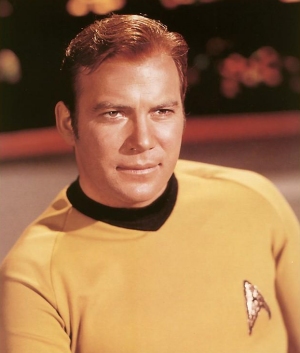
"Gentlemen, I suggest you beam me aboard."
So, as with any discussion of lead characters in a franchise, let's start at the beginning with the original series, and good ole Cap'n James T. Kirk, the most notorious badass in starfleet history. There are many reasons why TOS Trek is loved (its optimism, its progressiveness, its excellent writing), but Kirk is one of the more prominent reasons. He's one of those "women want him, men want to be him" heroes. Every other episode, he gets to tap some delicious alien ass, while simultaneously saving his crew from ultimate doom. Kirk is almost a Mary Sue, in that he is portrayed as so badass that no matter what happens, he will always find a way, whether it be through brains or force, to fix it. He is your All-American quarterback hero.
Despite the rest of the show being as great as it was, without Kirk it would never have been as great. Gene Roddenberry, the creator of Trek, imagined a world where a Japanese man would be allowed to pilot spaceships. To put this into context, Trek was introduced directly after WWII, when the Japanese were not too popular with the United States, especially since Japanese pilots raped Pearl Harbor. While we think nothing of it today, a Japanese helmsman on a spaceship was extremely controversial for the time. As were: a Black receptionist, a Russian gunner, a Hillbilly doctor, and a drunken Scotsman mechanic. Throughout this list of characters that people would not have readily accepted, Kirk rounded them off with that American bravado and do-right personality. He represented America in every way that mattered, and he was the leader.
Roddenberry was very clever to build his cast this way, but as much as he needed to glorify Kirk, he also needed to make him a human being. In writing, this is called pathos, and Kirk had a number of flaws that made him acceptable, and in some cases even a better leader. For one, he was very hand-on and would insist on going on away missions personally with his two closest friends (Spock and Bones). This may not seem like a "flaw" at first glance, but by doing so he puts himself at risk when he should be making orders. Leaders are not supposed to be Heroes, a rule Kirk never learnt. Kirk also has a nasty habit of letting his impulses cloud his judgement, and this has led to problems, even people dying. However, this is still balanced with a high level of confidence, professionalism and consideration which has led to Kirk being the model on which every sci-fi captain from any subsequent series since TOS.

"THERE, ARE... FOUR, LIGHTS!" -- Jean-Luc Picard
Which leads to Jean-Luc Picard. Picard is a completely different character to Kirk. Where Kirk is the quarterback, Picard is the head of the speech-and-debate team. Oh, he's still equally badass, just in a completely different way. He's more refined and more able to act as a diplomat, rather than fixing everything personally. In fact, most of the Next Generation (TNG) Trek revolved around various problems being solved with words and insight. This happened on TOS too, but nowhere near as often.
Too illustrate Picard's badassery, an episode from season three featured a colony that a group of aliens called the Sheliak were heading to claim. The Sheliak have a treaty with the humans, which states that they must give notice whenever there are humans on a planet they plan to colonize within their space. So, they contact the Enterprise and send them to pick up the colonists. It turns out there are way too many, and they need more time than the three days they were given, but the Sheliak are being bureaucratic dicks about it. It should also be noted that the Sheliak could simply blow the Enterprise into space dust, but Picard continues to put his ship between them and the colony. In order to try and reason with Sheliak, Picard plays their game by their rules. He reads through their treaty (which is about as long as some of my posts), and finds something in the fine print. He then contacts the Sheliak, and informs them that as there is a "dispute" over the time needed to evac the colony, he reserves the right to have an arbiter decide on the right course of action. The Sheliak, being the bureaucrats that they are, agree to a stipulation in their own treaty. Picard then chooses a species currently hibernating to arbitrate, who won't be available for several months. Then as the Sheliak try to protest, he hangs up. The Sheliak hail, and he just strolls around the bridge with a smug look on his face.
In other words, he just beat the very powerful bureaucrats at their own game, and when they try to call back, he puts them on hold.... I don't care what you say, that is badass. This is how Picard solves problem, rarely with force, but by talking it out, and if he can't find a diplomatic solution, intimidation and blackmail are always options too. Picard represents the inverse of the ideal leader of the 80s, a time when all the action heroes were beefy muscle-heads with big guns and bigger penises, here's a mid-60s bald guy who talks things out instead of shooting, and still manages to be more badass that Steven Segal. America had gone through a few wars since WWII and the Cold War had only just recently ended. There was still a lot of diplomatic tension at the time and Picard was basically a symbol of what people needed to be. Cool, collected, calculating, not just running in guns blazing. He was exactly the kind of man people would put in charge of the responsibilities he had. In keeping with the theme of the right man for the right job:

"Mr. Worf. Fire." -- Benjamin Sisko
Meet Ben Sisko, the man who was hired to assist with the reconstruction of a culture after a decades-long occupation by a cruel dictatorship. Oh, and he becomes a spiritual leader, too. The story of Ben Sisko is the story of the everyday-man. Doing his job, trying to keep everything together, raising a son as an only-parent and a widower and being the Emissary (conduit to the gods) of an entire species. It's not a light load to place on one man. Well, unless that man is Ben Sisko of course.
Sisko takes the best of both his predecessors, then adds his own unique flare. Like Kirk, he tends to use his fists to make the point, but like Picard, he has a political position to uphold as well. Also, where both Kirk and Picard were the captains of the flagship of the fleet and perfect men for the job in their respective eras, Sisko is in charge of some backwater station in the middle of nowhere, guarding some backwards species nobody cares about. But under his leadership, it becomes the most strategically significant position in the entire galaxy... yet another responsibility for who later becomes known as "the Sisko."
Neither Kirk nor Picard had children. Picard even loathed them for most of TNG. For Sisko to have a family is a huge change of pace for Trek, and his relationship with his son is one of the best portrayed in a television show. While he has a job to do, and he's in charge of a station where his son can easily get into trouble, his style of "set an example" parenting makes Sisko his son's hero, let alone his father. Jake grows as a character himself throughout the series, and everything about his growth as a character stems from his admiration of his father. At times, even when Sisko is busy with a war or a civil dispute or a crime committed on the station or any number of headaches he'd have to deal with, he finds the time to go and play some baseball with Jake. This is an example for all fathers out there who don't spend enough time with their children.
And is Sisko badass? Youbetcha! The man started a war, prevented a fascist coup within the Federation, held together an entire civilization and still found the time to be a dad. The best way to describe Sisko? SFdebris said it best: "Mr. Worf, prepare a photon torpedo, and write on it 'don't fuck with the Sisko.'"
But this of course, leads us too:
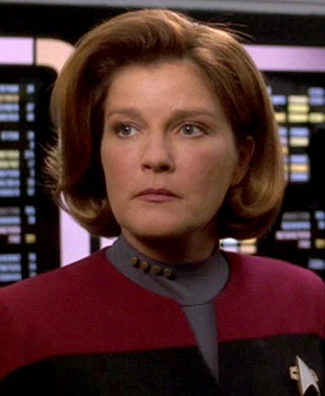
"There's coffee in that nebula" -- Kathryn Janeway
Captain Kathryn Janeway... and I'm afraid to say that this is where the awesome ends. Seriously, I have very little nice to say about Janeway, and that has very little to do with her as a character (there are some things about her, like her inflexibility, that annoy me, but there's plenty that doesn't), but the way she was written.
Let me just say right now, so as to avoid sounding like a chauvinist, I care less about the fact Janeway is a woman than her writers did. For some reason, they wrote her to be this authority figure that people would just blindly obey withouyt question. And in some sense, yes, that's the role of a captain, especially considering the context of the show she was in. But no, when half her decisions lead to people dying, losing considerable resources, or just plain NOT GETTING THE CREW HOME, I'd expect people not to take her so seriously.
Anyway, the context behind Voyager (VOY) is that the ship and it's crew have been flung into space and now have to embark on a 70 year journey to get home. They're cut off from any help, short on resources, possibly presumed dead, and just basically fucked. The captain that Janeway needed to be was the "mother of her crew" who would look after them and try to keep them together. But she wasn't. She was an idiot, and people followed her anyway because they were written too.
I am being a bit unfair. Come season five, she did improve and really start to take her role and responsibilities seriously. She recognized that it was partly her fault that they're stuck out here in the middle of nowhere, and at that point resolved to get her people home, no matter the cost. But then the show ended two seasons later, so all the good it did.
As a sidenote, Ron Moore, a prolific member of the writing team from TNG and DS9, would later go on to create the re-imagined Battlestar Galactica, a show with a remarkably similar premise to Voyager. And the character from that show was Bill Adama, a man who had this role down pat. He was the authority, but he was also a father to his crew and they looked up to him, not because he was the commander, but because he was doing everything he could to ensure their survival. This is the trait that Janeway lacked, and why I can't say I was a fan of the character, as much as the previous three.
But I still preferred Janway too...
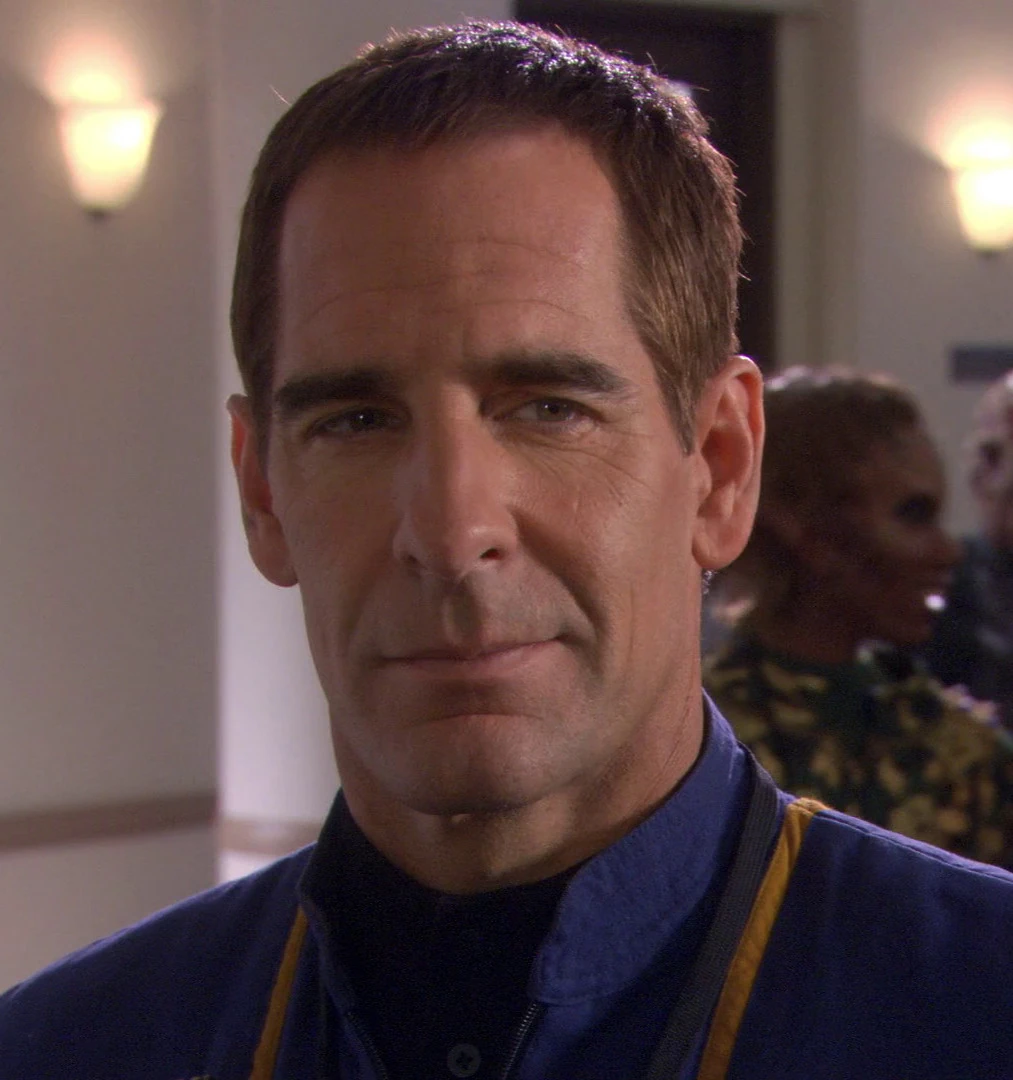
"Was it something I said?" -- Johnathon Archer
... this complete twirp.
So, now we come to the franchise-killer, Star Trek: Enterprise (ENT), the show that supports genocide by not doing anything. ENT was a prequel series, supposedly taking place before TOS, when man was only just starting out exploring the galaxy. It was a really great concept, and presented opportunities to see how all the conventions of the earlier series came to be. Except, it didn't amount to anything, partly because of good ole Archer.
The role that Archer is supposed to be playing in ENT is the role of Christopher Columbus, James Cook, Louis and Clark, explorers traveling to places nobody has ever been before. To do that, he needs to be a good diplomat (which he isn't), have strong leadership skills (which he doesn't), the ability to make tough decisions (again, he doesn't), the foresight to think ahead and consider all the crap that might happen (nope, he lacks that) a childlike fascination with discovering new worlds (likewise, he lacks) and again, freaking awesome diplomacy skills (he taunts Vulcans, the fuckwit).
Archer's idiocy is responsible for just about every problem the crew comes along. And there's nothing else I can add. He's an idiot, and the show led to the death of a great franchise in large part because they completely ruined his character. I happen to think Scott Bakula could've really delivered if they'd written someone more well-suited to his situation. But no, we got Duchess.
And with that, I apologize to my fellow nerds for ending this character study on such a depressing note. But really, the only thing I can say is that three out of five Trek captains were great characters. It's a real shame that they weren't all great.

I'm not a huge Star Trek fan but have watched soem over the years. I gotta side with you though, Janeway and Archer are the worst! I'll never forget the Mad magazine spoof of Janeway... funnee!
ReplyDelete